

Dashboard overview
The legacy live stream dashboard lists parent streams and summarizes status across any child feeds attached to each parent.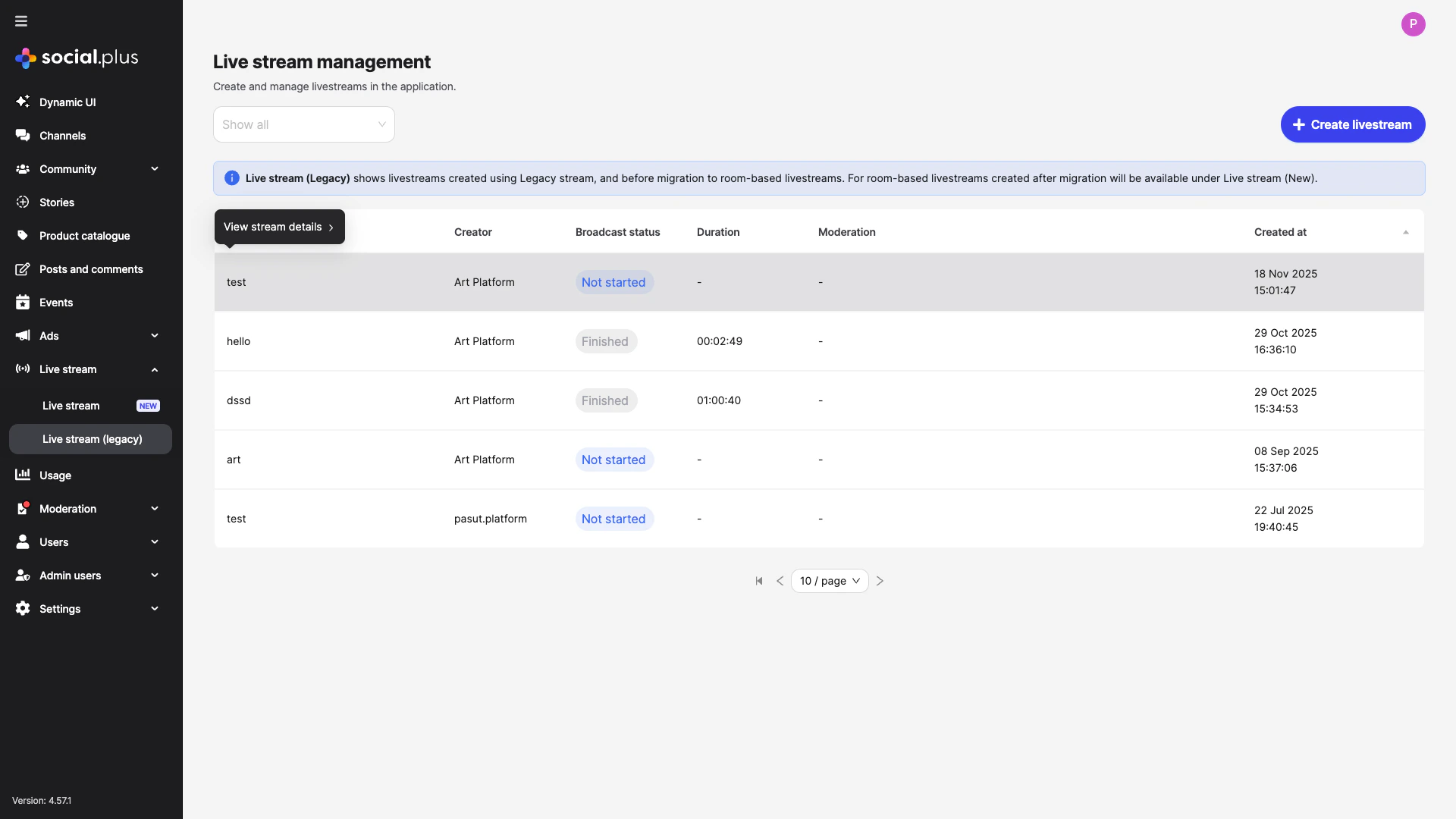
Use stream metadata to distinguish parent and child stream purposes, such as
mobile-view or desktop-view. SDK and API integrations can use that metadata to select the best stream for each viewer.Quick start
1
Create a parent stream
Set up the main live stream with a title, optional description, and optional thumbnail.
2
Add child streams
Add up to two additional feeds for device-specific views, camera angles, or other variants.
3
Create a post
Link the parent stream to a post so audiences can discover and join the live stream.
4
Monitor the broadcast
Track status, duration, and moderation across the parent stream and child feeds.
Create a parent stream
A parent stream is the primary live stream and the default feed for the live event.Parent stream fields
After creation, the Console generates a unique stream ID. Use this ID to link child streams and create posts. Broadcast setup choices, such as secure streaming and stream relationships, cannot be changed after the stream goes live.
1
Navigate to legacy live streams
Go to Console > Live stream > Live stream (Legacy).
2
Create a new stream
Click Create live stream.
3
Enter details
Fill in the title, description, and thumbnail.
4
Configure options
Enable secure streaming if needed and customize the camera feed name.
5
Confirm creation
Review the details and click Create to generate the parent stream.
Add child streams
Child streams provide additional video feeds under one parent stream. A parent stream can have up to two child streams, for a total of three simultaneous feeds.Child stream use cases
Mobile Optimization
Add a vertical 9:16 feed for mobile viewers.
Desktop Optimization
Add a horizontal 16:9 feed for desktop and tablet viewers.
Multi-Camera Events
Provide different camera angles for the same event.
Language Variants
Use the same visual event with different commentary tracks.
Add a child stream
1
Open the parent stream
Select the parent stream from the legacy live stream dashboard.
2
Add child stream
Click Add Child Stream. This action is available only when fewer than two child streams exist.
3
Review inherited details
The child stream inherits the parent title and description.
4
Customize feed name
Set a camera feed name. The default is
Additional feed 1 or Additional feed 2.5
Complete setup
Create the child stream and use its unique stream ID for broadcasting.
Edit stream details
Update stream details before or during broadcasts when event information changes.Copy live stream links
The available copy-link action depends on broadcast status.Delete child streams
Remove child streams that are no longer needed or were created in error.1
Select stream
Open the parent stream and locate the child stream to delete.
2
Start deletion
Click the delete icon next to the child stream.
3
Review warning
Check the confirmation modal. If the child stream is live, deletion immediately disconnects the stream.
4
Confirm deletion
Confirm to permanently delete the child stream.
Parent streams cannot be deleted while they have associated posts or child streams. Remove child streams and unlink posts first.
Broadcast status
Broadcast status is unified across the parent stream and its child feeds.Duration
The duration column shows the longest completed stream among the parent stream and child feeds.- Duration is calculated from stream start time to end time.
- Duration appears only after at least one stream has finished.
- If multiple streams have completed, the longest duration is shown.
- Duration remains empty until at least one stream completes.
Moderation status
Moderation status consolidates content review across the parent stream and child feeds.Prioritize red status codes first because they indicate critical content that may violate community guidelines or require immediate action.
Post integration
Create live stream posts that link to parent streams and automatically include associated child streams.For detailed information about creating and managing posts, see Posts Management.
When users view a live stream post, SDK or API based client applications can select the best stream based on device type, screen orientation, or custom metadata. UIKit applications display the parent stream only.
API-created streams
Streams created through the API appear in the Console. If the API request does not specify a camera feed name, the Console displays the default feed name. You can edit feed names later in the Console.Best practices
Multi-stream strategy
Multi-stream strategy
- Plan ahead: Decide which devices or production angles need optimized feeds before going live.
- Test thoroughly: Verify every stream is configured before broadcast.
- Name clearly: Use camera feed names such as
Mobile View,Desktop View, orCamera 2. - Use metadata: Add metadata that identifies stream purpose for SDK or API selection logic.
- Account for UIKit: Remember that UIKit displays only the parent stream.
Production quality
Production quality
- Choose strong thumbnails: Use engaging, high-quality preview images.
- Write clear titles: Make the event title easy to understand.
- Add useful descriptions: Give viewers context before they join.
- Enable secure streaming: Use secure streaming for private or restricted events.
Monitoring
Monitoring
- Watch unified status: Monitor all feeds from the Console during live events.
- Plan bandwidth: Ensure upload capacity for each simultaneous feed.
- Respect child limits: A parent stream supports up to two child streams.
- Review moderation: Investigate high-severity moderation statuses promptly.
Troubleshooting
Use cases
Mobile-First Events
Offer a vertical feed for mobile audiences while keeping a horizontal feed for desktop viewers.
Professional Productions
Support multi-camera productions with main-stage and close-up feeds.
Responsive Broadcasting
Let client applications choose the best feed for each viewer’s device.
Global Conferences
Provide polished desktop viewing while preserving mobile accessibility for remote attendees.
Technical specifications
Related topics
Live Stream Management
Manage current room-based live streams.
Posts Management
Create and manage posts with live stream integration.
Moderation Overview
Understand content moderation workflows for live streams.
Analytics
Track live stream performance and engagement metrics.